Minimossen offers entrepreneurs an opportunity to build businesses around reuse
The reuse gallery Minimossen in Vaasa offers entrepreneurs a unique opportunity to build businesses around reuse and the circular economy. We discussed the concept together with store manager Nina Hägen and business advisor Olav Nylund.

From Ekocenter to an entrepreneur-driven reuse gallery
Minimossen opened its doors in Storviken in autumn 2019 as an entrepreneur-driven reuse gallery focused on the circular economy and sustainable consumption. The concept was inspired by similar initiatives in Sweden and Norway, but also by local initiatives.
A predecessor to Minimossen was Ekocenter in Vaasa, founded by the City of Vaasa in 1989. The operation focused on reuse and employment initiatives, and was later transferred to Stormossen and later to the Jupiter Foundation. When Ekocenter closed in 2017, a gap emerged that Minimossen later came to fill.
"Today, Minimossen operates as a reuse gallery where small entrepreneurs rent sales spaces and sell reused products ranging from furniture and interior design items to clothing, electronics and leisure equipment" says Nina Hägen.
How the reuse concept works
The idea behind the operation is Stormossen’s ambition to make use of functional items instead of sending them to incineration. Reuse ranks among the highest levels of the waste hierarchy, and through Minimossen, circular thinking is put into practice.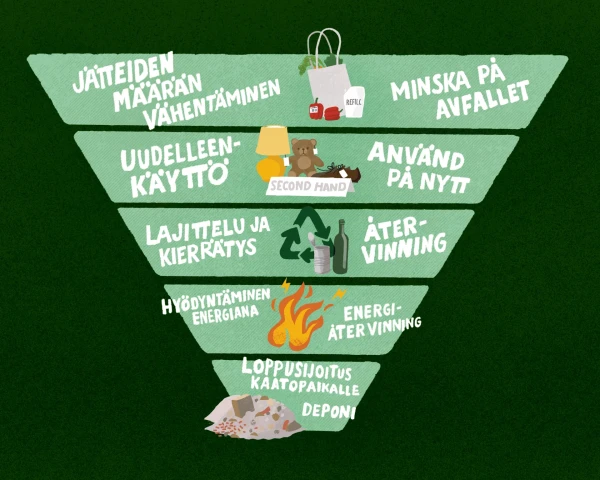
Every day, functional and reusable items are brought to Stormossen’s recycling stations. Instead of being sorted as waste, customers can choose to donate them to Minimossen. Donations can be delivered directly to the reuse gallery or to the recycling stations in Kvevlax and Vaasa.
The items are then passed on to the entrepreneurs at Minimossen, who clean, repair or redesign the products before putting them up for sale.
"The purpose of the concept is to make circular thinking easy for customers, both when it comes to sorting and consumption. Many items can still be used as they are, without needing to be broken down or recycled as materials" Hägen explains.
Being an entrepreneur at Minimossen
Today, nearly 20 small entrepreneurs operate at Minimossen. The reuse gallery sells reused furniture and interior items, sports and leisure equipment, tools, electronics, clothing, jewellery and household goods. The area also includes a café, tailoring services and knife sharpening services.
At the same time, the business model is relatively flexible and offers a low threshold for getting started. Entrepreneurs rent sales spaces of different sizes and pay a commission fee based on sales, while the store itself is managed by Stormossen’s staff.
This means entrepreneurs do not need to be tied to running a physical store every day, but can instead focus on product development, repairs and marketing.
"This is quite a unique situation for entrepreneurs. Normally, starting a business requires major investments in inventory and products, but here the core idea is that the material is generated through reuse and donations" says business advisor Olav Nylund.
According to Hägen, the sense of community between entrepreneurs is also an important part of the concept. At Minimossen, entrepreneurs receive support both from staff and from other entrepreneurs working in similar fields.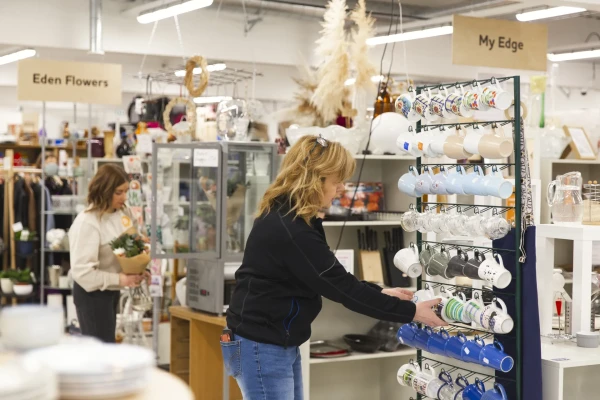
For those who see opportunities in reuse
According to Hägen, entrepreneurship at Minimossen is particularly suitable for people with a creative interest in reuse and sustainable consumption. The concept often works well alongside another business or as part-time entrepreneurship.
"You need an entrepreneurial mindset and be prepared for both quieter and busier seasons. It also helps if you enjoy creating, repairing and seeing potential in things that others might throw away" says Hägen.
"This can be a great fit for someone with a strong hobby interest, creativity and a desire to try entrepreneurship in a flexible way without taking the same financial risks as in many other industries" Nylund adds.
At the moment, the reuse gallery is looking for an entrepreneur interested in making use of home and interior textiles such as curtains, tablecloths, fabrics and decorative cushions. The donated textiles are often clean and intact, but still need to be sorted through.
"The textiles can either be priced and sold as they are or transformed into new products if the entrepreneur is interested in that. The person we are looking for has an interest in crafts and an eye for interior design" Hägen explains.
- More information about Minimossen, opening hours and contact details can be found on Minimossen’s website

- Running companies, new entrepreneurs, changes of ownership
- Innovation Boost project
- Regional responsibility: Malax, Vörå, Vaasa
